
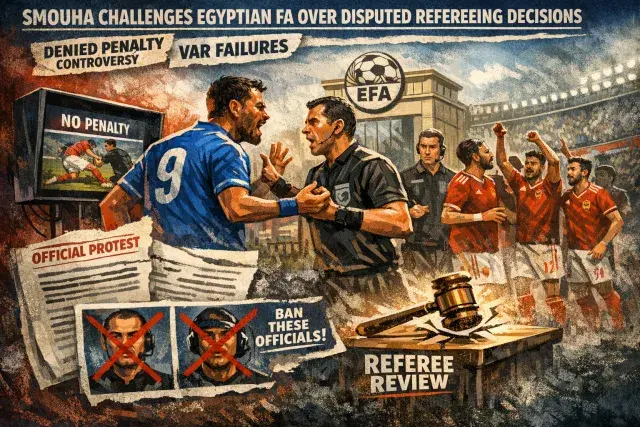

Smouha Club has filed an official protest with the Egyptian Football Association following its 2-1 defeat to Al Ahly in the second round of the Premier League's final stage, alleging that refereeing decisions — including a denied penalty and the failure of video review technology to intervene — directly altered the outcome of the contest. The Alexandria-based club has named specific officials and demanded their removal from any future involvement in its remaining fixtures this season. The formal complaint raises questions that extend well beyond a single result, touching on the integrity of officiating systems and the accountability mechanisms that govern Egyptian football.
The Incident at the Centre of the Dispute
The controversy crystallised in the first half, when a challenge between Al Ahly's Imam Ashour and Smouha's striker Samuel Amadi inside the penalty area went unpunished. Referee Mahmoud Nagi reviewed the situation in consultation with VAR official Wael Farhan before allowing the contest to continue without sanction. Smouha's protest states that the foul was "clear and valid," and that both the on-field official and the VAR operator failed in their respective duties — the former by ignoring visible evidence, the latter by declining to intervene despite having access to multiple camera angles.
Video assistant referee systems were introduced into elite competition precisely to eliminate high-impact errors of this nature. When the technology exists but produces no corrective outcome, the dispute inevitably shifts from whether a mistake occurred to why the mechanism designed to catch it did not function as intended. Smouha's complaint presses on exactly that gap.
A Broader Pattern, Not an Isolated Complaint
Smouha did not frame its protest as a response to a single incident. The club's letter to the Egyptian Football Association explicitly acknowledged that "numerous complaints from most clubs" regarding refereeing decisions have accumulated, and it called on the association to find systemic solutions rather than address grievances case by case. This framing — positioning the club's experience as representative of a wider institutional problem — shifts the protest from self-interest to a broader argument about governance.
The club was direct about the consequences: poor officiating, it argued, undermines the considerable investment made by clubs, technical staff, and those who work to raise the standard of Egyptian football. When results can be attributed, credibly or otherwise, to officiating rather than performance, the legitimacy of competition erodes. That erosion, over time, has measurable effects on institutional trust and public confidence in the sport's governing structures.
What the Club Is Demanding
Smouha's demands are specific and pointed. The club has requested:
- That referee Mahmoud Nagi and VAR official Wael Farhan be excluded from any involvement in Smouha's remaining fixtures during the 2025/2026 season — whether as centre official, fourth official, or video reviewer.
- That the Egyptian Football Association's Referees' Committee introduce sanctions for officials who make decisions that verifiably affect results.
- That the association treat this complaint as part of a wider institutional review rather than an isolated administrative matter.
The demand for a blacklist of named officials is unusual in its directness. While clubs in many countries have the right to formally protest results and officiating standards, requesting the permanent reassignment of specific individuals for an entire season represents a significant escalation — one the Egyptian Football Association will need to address on the record, whatever its decision.
Accountability and the Limits of Protest Mechanisms
The deeper issue raised by Smouha's complaint is structural. Football governing bodies in most countries operate officiating review processes that are largely internal, with outcomes rarely made public. Referees are assessed, errors are logged, and appointments are adjusted — but the process is opaque to clubs and supporters alike. That opacity, while designed in part to protect officials from undue pressure, also limits the ability of clubs to verify that accountability is real rather than nominal.
Smouha's letter acknowledged a degree of faith in the association's integrity — "we trust in the integrity of Egyptian refereeing," the club wrote — while simultaneously arguing that repeated incidents make that trust difficult to sustain. It is a careful rhetorical position: an appeal to institutional credibility as leverage for institutional reform. Whether the Egyptian Football Association responds with transparency or standard procedure will say something meaningful about where it stands on the question its own credibility poses.


