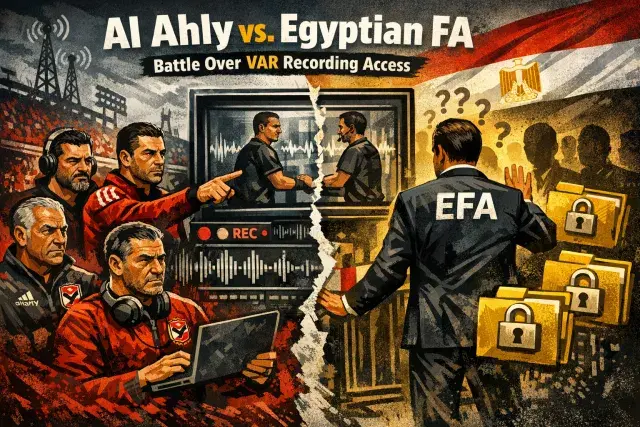
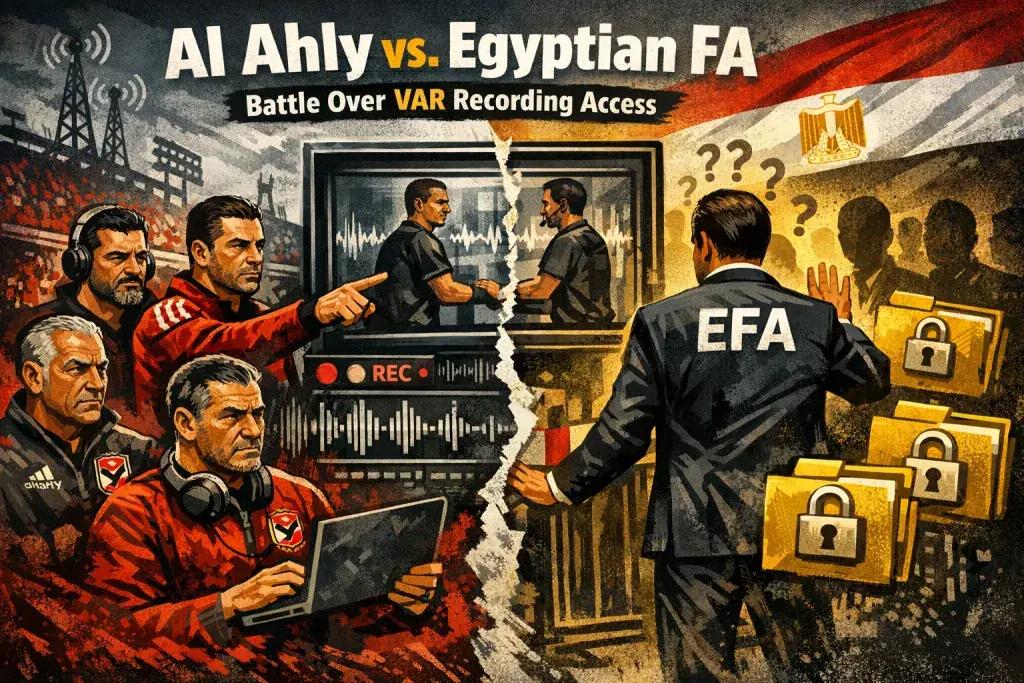
A procedural dispute between Al Ahly and the Egyptian Football Association has escalated into a public question of institutional transparency, after a scheduled session to review contested referee audio recordings collapsed before it could begin. The row, which has drawn commentary from prominent voices across the Arab media world, centres on who has the right to be present when sensitive officiating data is reviewed — and whether the Federation's conditions were designed to facilitate scrutiny or limit it.
What the Dispute Is Actually About
At the heart of the disagreement is a set of audio recordings capturing referee Mahmoud Wafa's real-time communication with the VAR review unit during Al Ahly's 1-1 draw with Ceramica Cleopatra in the opening round of the competition's final stage. Al Ahly disputed a late penalty appeal that was denied after VAR intervention, and the club subsequently requested access to the full referee-VAR dialogue — a process explicitly permitted under rules outlined by Referees' Committee head Oscar Ruiz, who confirmed that any club may access such recordings upon payment of the applicable fees and that the contents should be made public in the interest of fairness.
The Egyptian FA agreed in principle to the session, scheduled for Sunday. It then failed to proceed. The Federation's position was that only officials directly linked to the fixture — specifically those cleared to occupy the technical area during the original event — could attend. Al Ahly arrived with a delegation that included its director of football Sayed Abdel Hafiz, media director Jamal Gabr, an audio specialist and a former officiating professional. The Federation turned them away, stating that the individuals with legal authorisation to attend on its behalf were not present.
The Question Walid Al-Faraj Raised — And Why It Matters
Saudi presenter Walid Al-Faraj, writing on X, framed the standoff in terms that have resonated widely: "I don't understand why the EFA refused entry to the Al Ahly delegation… Is there something in the recording?" The question, deliberately left open, articulates a concern that many observers share — that the procedural argument over delegation composition may be functioning as a barrier rather than a safeguard.
Al-Faraj also noted the nature of the disagreement over who should attend: the FA wanted the club's football director and head of the technical staff, while Al Ahly wanted a board member, a former officiating expert and an audio technician. These are not equivalent delegations. The club's preferred composition suggests a goal of independent technical analysis — the audio specialist to assess recording integrity, the former referee to interpret the content with professional authority. The FA's preferred list would produce a narrower review conducted by figures embedded in the club's day-to-day operations, without independent expert input.
Transparency in Officiating: A Broader Institutional Challenge
The dispute reflects a tension that football governance bodies across the world have struggled to resolve since the widespread adoption of video review technology. These systems were introduced explicitly to reduce error and increase accountability. Yet the recordings they generate — detailed, technically complex and potentially embarrassing for officiating bodies — have frequently become subjects of access disputes rather than tools of open institutional review.
When Oscar Ruiz stated publicly that such recordings should be made available and disclosed, he was articulating a principle rather than establishing a guaranteed mechanism. The gap between stated principle and actual practice is precisely where this dispute now sits. Clubs that seek access find themselves negotiating not just the substance of what recordings contain, but the procedural conditions under which they can be heard — conditions set by the very institution whose decisions are under scrutiny.
That structural problem — a body adjudicating the terms of its own accountability — is not unique to Egyptian football. It is a recurring flaw in governance frameworks where oversight and operations are housed within the same authority. Independent arbitration panels, third-party audit rights over officiating data, and pre-agreed protocols for delegation composition would each reduce the scope for procedural obstruction. None of these appear to be in place here.
What Happens Next
Al Ahly has not publicly withdrawn its request for access to the recordings, and the Egyptian FA has not, on the available record, formally denied it — the session was called off on procedural grounds, leaving the underlying request unresolved. The longer this takes to reach a clear conclusion, the more corrosive the uncertainty becomes: for public confidence in the officiating process, for the Federation's credibility as a neutral administrator, and for Al Ahly's ability to pursue a legitimate institutional grievance through legitimate channels.
What began as a question about a single denied penalty appeal has become a test of whether Egyptian football's governing institutions can be held to account by the clubs they oversee — and whether the transparency frameworks they publicly endorse are enforceable in practice or aspirational in name only.